The Corpus Callosum was written in the middle of Wallaby.
That fact belongs in the first paragraph because hindsight lies.
Once a system has two hemispheres named Castor and Pollux, the architecture looks inevitable. Exact retrieval on one side. Living recollection on the other. A bridge between them. Of course that is what the project was always building.
It was not.
The_Wallaby_Why came first. Track_Meet_Doctrine followed weeks later. They established the need and the method. The Corpus Callosum arrived after the apparatus had accumulated enough contradictory results to require a new organ.
It was an R&D finding before it was a foundation document.
One reader, two incompatible jobs
The early architecture kept trying to make one process do everything.
Find the exact source. Preserve the emotional register. Be comprehensive. Be surprising. Follow the question. Escape the question. Return one answer. Keep the ambiguity.
Each goal made sense alone. Together they produced compromise instruments that were neither trustworthy nor alive.
A factual retriever optimized for provenance tends toward convergence. It wants the best match, the correct identity, the complete set, the answer that another run can reproduce.
A living recollector needs room for path dependence. It may move from one passage to another because the posture rhymes. It may protect a quiet catch that appears only once. It may return two incompatible readings because the incompatibility is the honest shape of the record.
Forcing those faculties into one score did not combine their strengths. It erased the distinction that made either useful.
The architectural answer was not a better blend.
It was lateralization.
Castor
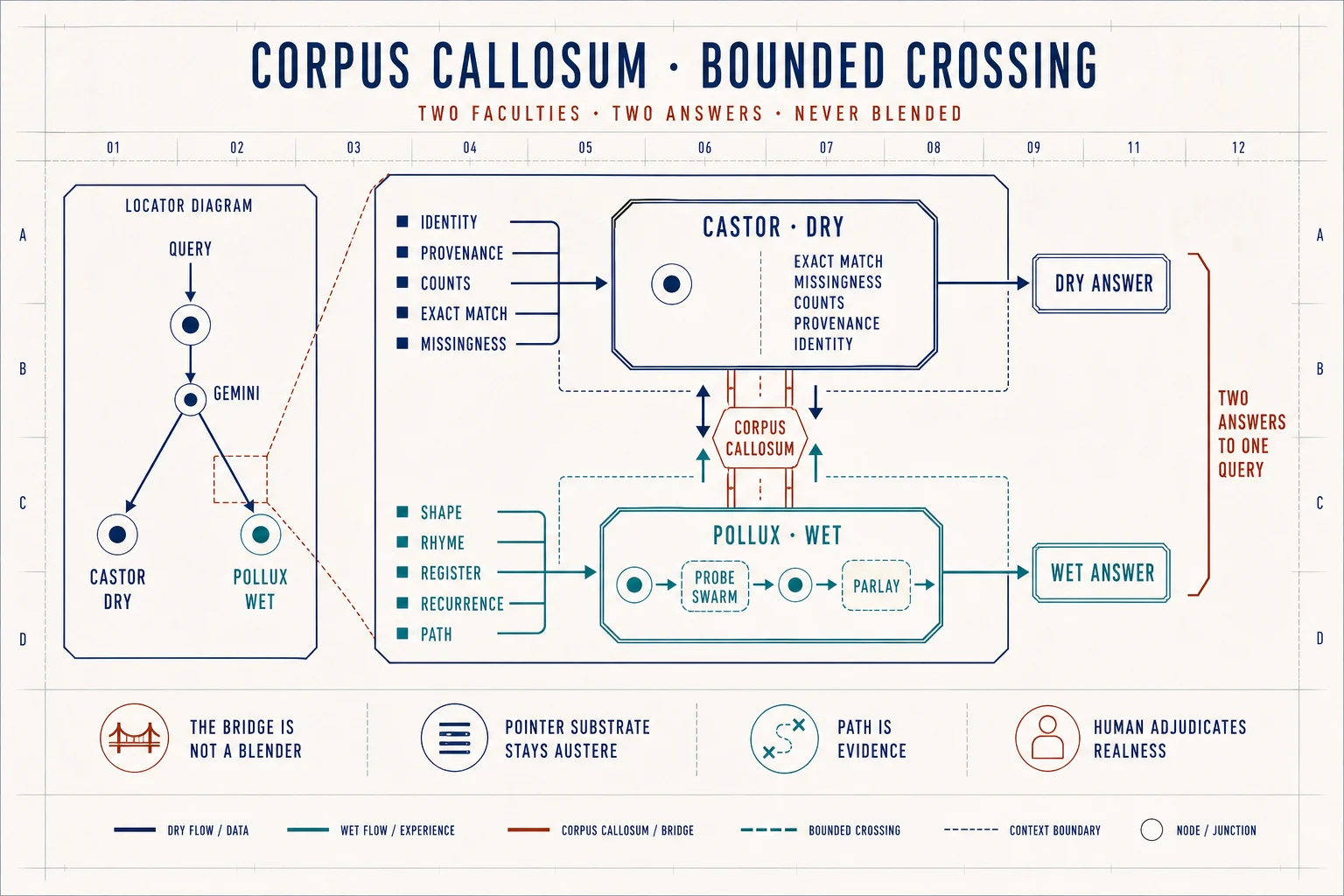
Castor is the dry hemisphere.
Dry does not mean cold. It means determinate.
Castor owns the questions whose answers should converge:
· Which conversation is this?
· Which message anchors this node?
· Which snapshot contains it?
· Does the count mean headers, distinct messages, rows, catalogs, nodes, or anchors?
· Did this result actually come from the floor?
· What is missing?
Castor’s austerity is a virtue because these questions do not become richer through plurality. Five different message counts are not five perspectives. They are a defect.
This is why the node layer belongs largely to Castor’s jurisdiction. A pointer should be accurate before it is evocative. Its declared reach should correspond to the ground it claims. Its identity should come from content, not a convenient filename. Its summary should not fuse several subjects because the fusion makes prettier prose.
The project had to state this boundary later: the Corpus Callosum’s wet interpretive doctrine does not license a wet pointer substrate.
The bridge depends on each side keeping its job.
Pollux
Pollux is the wet hemisphere.
Wet does not mean vague. It means alive to a different class of evidence.
Pollux cares about shape, rhyme, register, recurrence, and the path by which a thing became salient. It can follow a question to the right shelf, set the question down, and move through the stacks by what catches.
The graph may help locate a starting region. It does not get to decide the walk. Semantic nearness is useful for convergence. Cross-domain rhyme often lives at a distance.
Pollux therefore needs constraints that look strange from a search-engine perspective.
Its path must remain visible. Its returns must keep their provenance. Its off-axis catch cannot be merged into Castor’s answer before anyone sees which instrument found what. Its plurality cannot be averaged into a single “best” recollection without destroying the evidence carried by the split.
Pollux prevents a perfectly indexed life from becoming an encyclopedia no one recognizes as his own.
The bridge
The Corpus Callosum is not a blender.
It is a bounded crossing.
Castor can hand Pollux a referential outline. Pollux can color inside it without claiming the color is exhaustive fact. Pollux can return a shaped recollection. Castor can attach the path and source without reducing the recollection to keywords.
The two sides can inform one another while remaining legible as different faculties.
That separation produces Gemini.
A query fires both twins. Castor returns the dry read: on-target sources, identities, provenance. Pollux returns the wet read: the shape and rhyme that the direct answer alone cannot carry. They are delivered together and not merged.
The non-merge is load-bearing.
A dictionary can be Castor succeeding and Pollux failing. A poem from the same era can be Pollux succeeding and Castor failing. Merge the results too early and the system loses the information needed to know which faculty did its job.
The eight principles
The Corpus Callosum became a constitution because the split kept recurring beyond retrieval.
It carries eight numbered Principles, and it is one document’s share of a larger body — the Track Meet Doctrine holds twelve, The_Wallaby_Why holds eight more. Their full force is larger than any compact paraphrase, but six of the eight became operational law in daily practice:
· The apparatus is two hemispheres and the thing between them. Neither side is “the reader.” Both are. The bridge is what lets them be one mind.
· A living read must not be starved into austerity by excessive structure.
· Two good readings may be tiling faces rather than competitors.
· The apparatus can surface the flower; the human rules whether it is real.
· Read the process, not only the result. An unspecified seam will be filled by the instrument’s default disposition.
· Convergence is not automatically truth, and divergence is not automatically error.
The “peace prosthetic” is central. The system should be capable of holding two irreducible readings without forcing a victory. This is not indecision. It is an engineered refusal to make resolution where the evidence does not support it.
The austere default
One of the most important findings was about unspecified mechanisms.
An instruction such as “steer by salience” sounds wet. Implemented naively, it can become a hill-climb toward the loudest category. The walker keeps taking the highest-salience next step until the entire run becomes one kind of thing.
The dry interpretation hides inside the blank.
If a mechanism does not specify how diversity is preserved, the instrument will often fill the seam with ranking, maximizing, and grid-making. Those are powerful habits. They are also convergence pressures.
Wallaby’s answer was not to write a larger personality prompt. It changed the mechanism. Context dampening made a walker sample different neighborhoods instead of climbing one ridge. Multiple entry doors made path variation observable. Later, the Leda Creed used an intentionally minimal induction to test whether a reader could remain alive without being boxed into a rubric.
And the finding underneath the finding: the two piles could not be told apart by their contents. A find reached by a real wander and a find reached by a hill-climb can be the same node, the same text, indistinguishable on the desk. The only place the difference was legible was in the shape of the path that reached it.
The lesson was not “less prompting is always better.”
It was more precise:
If freedom is part of the instrument, excessive instruction changes the instrument.
P7: the human realness seat
The most consequential boundary is the final one.
Wallaby does not decide whether its own recollection is real.
It can check provenance. It can compare independent paths. It can expose shared structure and single-witness catches. It can run a blind read, a cross-read, and a read of reads. It can remove a judge that failed a mechanical gate. It can collate every surviving verdict without dropping one.
It cannot certify wetness.
Any layer that tried would grade the output using the same family of habits that produced it. The evaluator would inherit the instrument’s blind spot, then convert that shared blind spot into a pass stamp.
The final call stays with Jake.
That is not an anti-automation exception. It is separation of powers.
The apparatus surfaces. The person adjudicates realness.
What fell out of the bridge
Once the two-faculty architecture existed, several later systems became possible.
Leda could own no-query recall without being forced to behave like search.
Gemini could pair a dry query read with a wet one without blending them.
The Probe Swarm could treat independent paths as evidence.
The Parlay could become a read of reads whose job was to preserve plurality rather than synthesize it away.
The judgment layer could distinguish mechanical validity from interpretive realness.
None of those systems is merely the Corpus Callosum turned into code. Each has its own failures and corrections. But the bridge supplied the grammar needed to see those failures correctly.
When the Parlay’s judges were given raw floor material and flattened the result, the diagnosis was a layer error. Judges should read the walkers’ reads, including their paths, because the path was part of the wet evidence.
When node-quality work tried to import wet doctrine into catalog pointers, the diagnosis was another layer error. The node substrate needed austerity.
The same constitution ruled in opposite directions because the sides were finally named.
Why it deserved its own document
The Corpus Callosum marked the moment Wallaby stopped asking one machine to become a perfect reader.
The project began designing a society of partial faculties instead.
One keeps the record. One moves through it. One checks identity. One notices rhyme. One preserves paths. One collates. Several read independently. None is allowed to quietly become the whole mind.
That is the larger architecture.
Not a model with more context.
Not a better retrieval score.
A cognitive system whose components have different jurisdictions, whose crossings remain visible, and whose final seat is deliberately left outside the machine.
The bridge was discovered because the experiments made the single-reader fiction impossible to maintain.
Then it became foundation.