ethosteleos.dev

A character forged by its ultimate purpose.

The work behind the résumé

Jake
Botticello.

Forward-Deployed Engineering · Applied AI · Grants Leadership

I turn complicated problems into systems people can actually use.

I build and run production AI systems, own the customer problem from discovery through delivery, and bring a substantial background in technical consulting, grants, regulation, and operations. I direct coding agents to write the code. Architecture, judgment, and responsibility for the result stay with me.

This is the longer story: the companies I’ve run, the institutions I’ve worked inside, the systems I’ve shipped, and the other experiences that belong alongside them.

How I build

Formal spec.
Adversarial review.
Live verification.

I direct coding agents through a formal spec, adversarial-review, and live-verify pipeline. The agents write the code; I own the architecture, customer delivery, and decision to ship.

Three connected drafting stations: human judgment and specification, documents under review, and a running system being verified.
  1. Formal spec

    Define the requirements, constraints, and evidence of success. Build against that specification.

  2. Adversarial review

    Challenge the implementation and the proposed fixes, including payment and authorization boundaries.

  3. Live verification

    Load the deployed system and exercise the actual workflow. A passing build is a checkpoint.

Experience

The job titles tell you where I was. The interesting part is what I was responsible for, who depended on the work, and what it took to carry it through.

Pyris Consulting

Founder & Principal

From the first ambiguous conversation to the system running in production.

At Pyris, I build and run production LLM agents and business automation systems for founder-led businesses. I own discovery, architecture, development, delivery, deployment, and live operation. That means understanding the business well enough to decide what belongs in the system, explaining the tradeoffs to the founder, and staying responsible after the software is deployed.

I direct AI agents, mainly Claude Code and Codex, to write the code. The process is explicit: specification, build, adversarial review, and live verification. Architecture and customer ownership stay with me. The agents are how the implementation gets built, and I take responsibility for the result.

The work ranges from Cyris, a conversational front door that schedules appointments and conducts consulting diagnostics, to CCF’s recruiting, intake, and payment workflows. Some engagements extend into fractional-COO responsibilities. A software change can be part of the answer, but so can the operating structure around it. And, of course, the solution has to fit the organization it's built for - not the other way around.

I also write down the reasoning behind client systems and transfer the work through walkthroughs, technical exchanges, and live working sessions. A delivered system has to make sense to the people who will operate it.
Explore the engineering work Pyris Consulting

Lucid Software Solutions

Founder & President

A two-person SaaS company, with the customer and the product on my side of the desk.

Lucid was a two-person custom CRM SaaS company. My partner wrote the code; I owned architecture, product, requirements, UI decisions, customer relationships, contracts, rollout, support, and the books. We were small enough that those responsibilities stayed closely connected.

We shipped and operated custom CRM software for independent wireless retailers and insurance businesses whose carrier systems would not let them retain their own customer relationships. Customers also included dealership franchise owners. I worked directly with the COO and CTO at the wireless retailer, the CEO at the insurance business, and owners at the dealerships.

The largest customer was a wireless retailer with roughly 4,000 employees, reaching 4,450 at its peak. A two-person company delivering into that environment had to understand both the executive’s problem and the practical decisions inside the product. I carried the work from requirements through rollout and the continuing account relationship.

That was product and technical delivery long before my current AI work. The implementation method has changed; owning the customer, architecture, and business around the software remains part of my job.

Ultimate Medical Academy

Director, Grants Research & Development · now Vocate

Building the grants function meant building the institution’s ability to do the work.

At UMA, a national nonprofit healthcare institution, I built the centralized grants department from the ground up and managed a team of about six. The job reached across the organization: program needs, institutional readiness, funding strategy, financial review, and the procedures connecting those pieces.

I designed pre- and post-award workflows, assessed eligibility and financial risk, and translated funder directives into actionable guidance for program and finance teams. I rewrote fiscal and acquisition policy to align with federal Uniform Guidance, 2 CFR 200, alongside Department of Education, Department of Labor, and state-funder requirements.

The department and institution received approximately $2.5M annually against approximately $15M in annual requests. Those are department and institutional outcomes. My contribution was building and directing the function, shaping strategy, reviewing the work, and installing the policy and operating discipline behind it.

Quarterly reviews of win rates, reviewer feedback, and funding trends helped refine the strategy. The work included improving first-pass proposal approval rates and using Copilot for AI-assisted editing within the institution’s review process. Writing, management, and compliance were all part of the same operating responsibility.

Department building and grants governance

Triad Associates

Senior Associate

Technical consulting in a world of public obligations, funding rules, and overlapping stakeholders.

My official title at Triad was Senior Associate. Senior Project Manager, Economic & Community Development Consultant, and Grant Writer were roles I held under that title. I developed long-term funding strategies, managed grant lifecycles, and integrated technical, demographic, and economic evidence into infrastructure and development proposals.

This was highly technical consulting. Municipalities and counties have legal and regulatory obligations, and the state and federal funding they pursue comes with its own requirements. A convincing proposal has to make the project work across those boundaries. I reviewed regulations, financial statements, budget narratives, and cost allocations while coordinating clients, contributors, and subcontractors.

I managed eight of the firm’s ten largest client relationships and tripled business from the existing clients I worked with. I also developed passive accounts into active, committed engagements and coordinated with a multidisciplinary team of approximately twenty. Those responsibilities combined client trust, discovery, and the practical work of getting a project delivered.

During COVID-era funding changes, I interpreted new federal relief legislation for staff and public-entity clients while the guidance was still moving. I also served as project director on an approximately $36M multi-county federal fiber infrastructure award. The award was a team and firm win; my role was directing the project within that effort.

Funding, regulation, and infrastructure

Cellular Sales

Operations Manager & Trainer · Verizon partner

Keeping a market running meant making the work understandable and repeatable.

At Cellular Sales, I trained and managed the market’s sales staff and operations team. At its largest while I was there, that meant up to approximately 225 sales representatives and ten operations staff across 25 retail locations. I ran market operations through long stretches of absentee ownership.

I trained more than 200 staff, wrote the operating procedures the market ran on, and maintained a shared reference for pricing, inventory, and operational standards. I also created executive presentations, facilitator guides, and training materials. Those documents were working tools for the people carrying out the job.

This role overlapped with Lucid. One side of my work involved designing software around a customer’s business; the other involved the day-to-day responsibility of running an operation and helping its staff execute consistently.

Skills

Here is what I bring to the work, with examples of where I’ve used it. The tools matter because of the problems they let me solve.

Architecture, integration, and agents with real operating responsibilities.

I design production agent systems, model-facing tool interfaces, context management, and evaluation harnesses. "Cyris" is an example of conversational software acting against calendars and payment systems, while also serving as a "Senior Consultant" who provides small business AI-Readiness and Operations Systems audits. "Skip" is an example of keeping the database contract on the server while letting the conversation remain flexible and in alignment with the intended audience.

My systems use Python, TypeScript, JavaScript, SQL, Node.js/Express, React, and Supabase/Postgres. Integration work includes REST, webhooks, Stripe, Google Calendar, Gmail, OAuth 2.0, and HMAC. I work mainly with Claude Code and Codex through directed development, and use MCP servers to give coding agents the context and tools they need.

The FDE Portfolio page explains the decisions those tools support: protecting payment workflows against redelivery, validating intake before it reaches storage, keeping two systems consistent, and making a derived context index verifiable.

Cyris: authority outside the model Alexandria: context with provenance

Understand the problem, defend a workable plan, and stay through delivery.

Client discovery, requirements analysis, regulatory interpretation, and account ownership run across Lucid, Triad, UMA, and Pyris. The setting changes, but the responsibility remains concrete: understand what the customer/stakeholder needs, identify the constraints, explain the options, and carry the work through.

At Lucid, I worked with executives and owners on custom software. At Triad, I managed major client relationships and developed technical funding proposals. At UMA, I sought alignment between partners and program directors. At Pyris, I own the system from the initial conversation through live operation, including the written reasoning and working sessions that help a client take ownership of the result.

Lucid: product and customer ownership Triad: consulting across constraints

A funding strategy has to survive eligibility, budget, review, and implementation.

My grants work includes research, development, compliance, funder relationships, proposal writing, financial review, and grant lifecycle management. I have negotiated grant agreements, subcontractor agreements, and NICRA, and have working experience with the FAR.

Program experience spans the Economic Development Administration, Agriculture, Environmental Protection, Education, Labor, Transportation, congressional community-project funding, FAA, NSF, FEMA, and the National Endowment for the Arts. Foundation, corporate, state (particularly New Jersey and Florida), and county work sit alongside those federal programs.

Much of this technical consulting involved high stakes and high pressure. Public needs were often the priority, while project development and budgets had to meet local, county, and state regulations alongside federal or state funding requirements. In that work, I presented to and briefed New Jersey’s Lieutenant Governor, the State Senate President, and numerous members of the Assembly.

I use research and collaboration tools including Instrumentl, Candid, GrantWatch, grants.gov, SAM.gov, Teams, Google Workspace, and Monday.com. Their purpose is coordinating evidence, contributors, and deadlines across a process with consequences for the institution and its funders.

Read the grants portfolio

A system is useful when people can work inside it.

I have managed sales and operations staff, grants teams, and volunteer moderators, and coordinated with multidisciplinary consulting teams. That work includes training, operating procedures, escalation policy, and the materials people use to make decisions when the manager isn’t beside them.

Communication is part of delivery. I’ve presented to public-sector executives, lectured at the statewide annual municipalities conference, taught staff, and published technical build logs. My earlier performance history adds another register: years of live music and spoken-word work in front of an audience.

Operations at Cellular Sales Speaking, teaching, and performance

FDE Portfolio

These are systems I’ve built, shipped, and run. I own the architecture and delivery, directing coding agents through the implementation. The useful detail is in the business problem and the decisions made to solve it.

CCF/Skip

Recruiting, conversational intake, and real payments

A family’s conversation has to become a usable record. Their payment has to become exactly the right transaction.

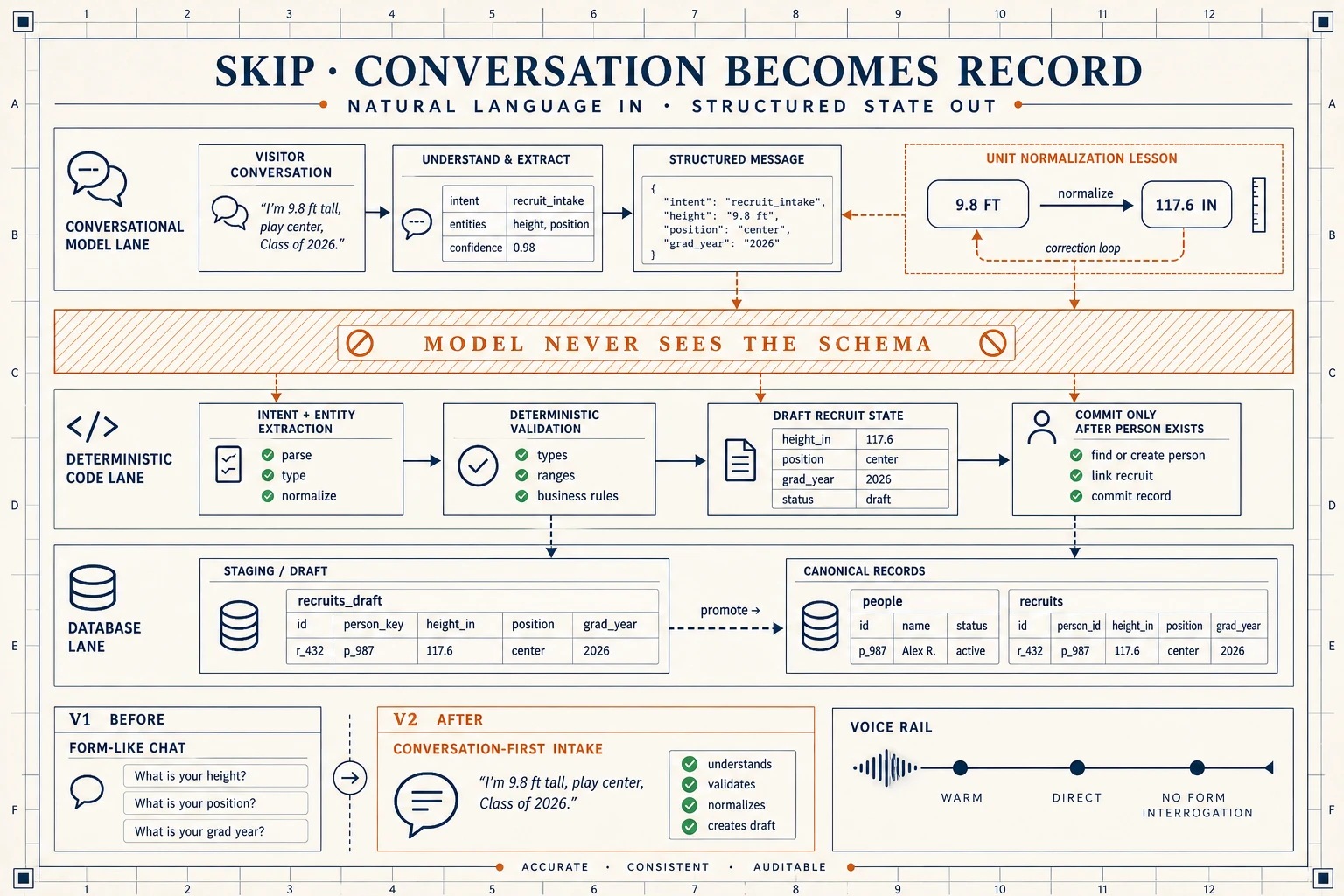
System map showing the boundary between Skip’s conversation, semantic tools, and server-owned records.
Skip · the conversation stays flexible; the storage contract stays on the server.

CCF is a live recruiting platform taking real Stripe payments, and I continue working on its systems. Its workflows combine recruiting operations, conversational intake, and billing. That makes the seams important: what the family says, what staff need to know, what the system stores, and what Stripe actually did.

Skip was built to replace an intake form with more than 30 fields and a conversion rate below 2.5%. My view was that the teenage student-athletes completing it were too busy to work through that much content. The goal was to give them a text message, DM, or chat environment that felt more familiar.

We introduced Skip as a conversational intake agent. He can ask several questions at once and pick up where the conversation left off after an interruption. His voice is usually casual, intended to feel natural to teenage student-athletes. When someone identifies themselves as a parent, he shifts toward the tone of an adult discussion. Since introducing Skip, intake conversion has risen above 34%.

Skip keeps database tables and columns outside the model-facing interface. The agent works with semantic fields; the server maps them into storage and validates numeric types and coarse ranges before writes. A broad-jump answer of 9.8 becoming 117.6 exposed the need for that upstream gate. Rejected values preserve the prior stored field and retain the raw answer for review.

The conversation also captures material a rigid form can miss. Skip synthesizes off-script family circumstances, motivations, and concerns into staff highlights. If someone leaves early, the intake remains open rather than being falsely marked complete.

On the payment side, I traced a live double-charge through Stripe’s event log to an orphaned draft invoice and its auto-advance timer. I made the customer whole with an apply-forward credit and implemented layered idempotency for checkout links that could outlast Stripe’s idempotency window. The incident led to a structural correction to the payment path.

A registry for critical alerts rejects unknown marker names and distinguishes paged money-risk events from log-only events. Intake validation, billing correctness, and operational visibility all belong to the same delivery: a system serving real families.

Read the Skip project brief Read the recruiting platform brief

Cyris

An agent running a consulting workflow

The conversation does useful work before a human consultant takes over.

Cyris is the conversational front door of Pyris Consulting. He schedules appointments, conducts an AI-readiness audit, and runs a business-operations diagnostic in the posture of a senior consultant. The findings pass to a human consultant for the build.

One agent loop uses five versioned playbooks over a shared tool layer. The scheduler and diagnostic voices have different jobs, while calendar, email, and payment capabilities remain in one maintainable system. I designed the architecture and shipped it through directed AI development.

The scheduling tools query live availability and check that the selected appointment fits before insertion. Cancellation and rescheduling require a server-verified HMAC possession token. The tools take no model-supplied target arguments, so the model cannot choose somebody else’s appointment to cancel.

Paid intake depends on a webhook-verified payment record. Card redaction runs at persistence sinks, email recipients bind to verified session addresses, and rescheduling books the replacement before releasing the old appointment. Those boundaries are what make the conversational interface usable against real operating systems.

The consulting side matters just as much. An AI-readiness interview reconstructs actual processes and their costs; the operations diagnostic examines how the business runs. The result is a next step grounded in the business, with human responsibility for what gets built afterward.

Read the Cyris project brief Meet Cyris at Pyris

FluxEngine

Outreach, deliverability, and a workflow the customer can operate

The customer first had to see why the email system was worth building.

The stakeholder for whom RecruitMail was built initially disputed the need for an email system. I demonstrated industry benchmarks and a path from three to four hours of campaign creation to approximately fifteen minutes. That changed the decision to build. The resulting workflow takes ten to fifteen minutes per campaign.

RecruitMail evolved into FluxEngine. RecruitMail sent over 100,000 emails and, as of October 12, 2026, FluxEngine is live on CCF and sending about 50,000 emails a week. The confirmed engagement rate is 12.5%, roughly four times an industry benchmark of about 3.3%. These figures describe different measures: weekly volume, engagement, and its comparison.

The engineering sits behind those measures. Scheduling, sender limits, cooldowns, token-revocation handling, bounce suppression, and bot-aware tracking let the system keep operating beyond a successful first send. Scanner activity can inflate apparent engagement, so suspected bot opens and clicks are identified and previously credited engagement can be rolled back.

FluxEngine’s reports feed recruiting operations for clients, staff, and public profiles. Live reporting is provided to staff, as well as the recruits and their families. The delivery includes campaign creation, transport, and the evidence the business uses afterward. The predecessor’s historical send volume is a separate record from the current deployment.

emails per week
~50,000
confirmed engagement
12.5%
the ~3.3% benchmark
~4×
Read the FluxEngine project brief

The Situation Room

A multi-vendor coding room

Multiple coding agents need a shared operating structure and communication layer if they’re going to work together.

I designed and built a Windows-based coding room by directing a cross-vendor agent team. It gives agents seated roles for orchestration, engineering, landing, validation, adversarial other-agent review, and quality control. A local Python daemon, an append-only SQLite event log, local database structure, live context system, and a live cockpit support the work.

The room brings shared permission checks, authenticated generation handshake-required handoffs, and Windows process custody into one operating structure. Agents can hand work between sessions while maintaining each role’s responsibilities. Any agent that can use a local MCP server can take a seat.

The recorded deployment orchestrates more than ten agents from more than five labs/vendors. A bounded native-mail pilot reduced median message-to-order time from 34 seconds to three seconds and typed wakes from five to zero. In a separate receipt pilot, all thirty request receipts matched transcript usage. Those are results from the named pilots, rather than a blanket performance promise.

The project makes the development method itself explicit. Who can act, who reviews, where a decision is recorded, and how work survives a session boundary are operating requirements of the room.

median message-to-order timeNative-mail pilot
34s → 3s
receipts matched usageSeparate receipt pilot
30/30

Alexandria

Context management for coding agents

A fresh coding session should spend its context on the work, rather than rediscovering the project.

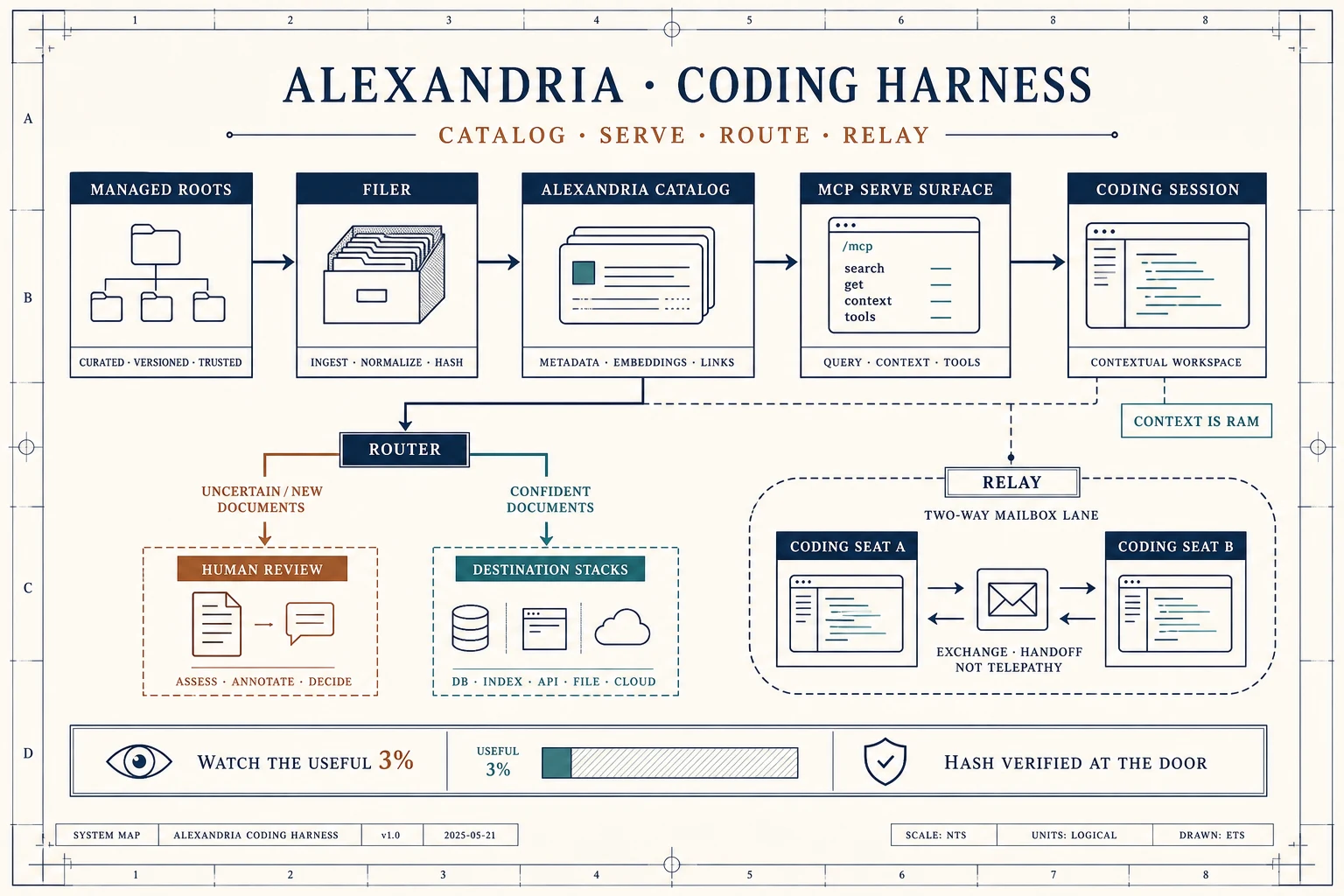
Alexandria system map connecting the catalog, file descriptions, selective MCP retrieval, and coding sessions.
Alexandria · a derived map, verified against the source it describes.

Alexandria is a home-grown Python MCP server and context-management system. It boots and re-anchors coding sessions against project references, serves concise descriptions, and verifies the files behind them. The sessions that build it use it to orient their own work.

The central decision is to pay for comprehension when a file changes. A locally launched background process asks a cloud Claude agent to describe the changed file, then stores the description in a derived index. The reading session can inspect the map and fetch only the material it needs. Source files remain authoritative.

Content hashes determine whether material changed. Read-time verification checks the source against the index, while pruning and startup reconciliation handle deleted files and changes to the served boundary. Failure logs preserve distinct causes rather than reducing every failure to the same unhelpful message.

The router uses learned hints, batched classification, and human rulings for uncertain placements. A correction teaches the system while preserving the boundary between inferred routing and configuration. The useful result is selective context with provenance and a visible correction path.

Read the Alexandria project brief

RecruitHQ

Operations around an immovable public CMS

The business needed operational tooling while its public player profiles stayed on Wix.

RecruitHQ covers lead intake, calls, notes, follow-ups, scheduling, enrollment, invoices, payments, service planning, and public player profiles. I delivered the platform around the constraint that the public Wix CMS could not simply be replaced. It processed more than $100K over approximately six weeks.

A bidirectional Wix and Supabase/Postgres mirror translates schemas between the public CMS and operational records. Nightly reconciliation backstops the live mirror. That lets the business continue working across the two surfaces while maintaining consistency.

Role-scoped access separates the operating surfaces, and FluxEngine reporting feeds client, staff, and public views. I also designed and shipped an SVG engagement map with a six-level intensity model and click-to-cross-filter interaction, calculated from sent and engaged counts by state.

The work is a practical integration problem: build what the operator needs without breaking the public system the business already depends on. The control plane, translation layer, and reconciliation process are the architecture that follows from that constraint.

Grants Portfolio

Funding work combines persuasive writing with regulation, financial review, relationships, and delivery. Here are the responsibilities behind the awards, with personal contributions kept distinct from team and institutional outcomes.

Building the Grants Department at UMA

Institutional strategy and an operating function

The department needed a way to turn institutional priorities into a coherent funding program.

I built UMA’s centralized grants function and its workflows, managed a team of about six, and designed the organizational development plan for a philanthropic funding pipeline. The work reached across the institution rather than sitting inside a single program.

Assessing an opportunity meant examining eligibility, competitiveness, regulatory requirements, institutional readiness, and financial risk. I translated those findings into guidance for program and finance teams and developed review procedures connecting the proposal, budget, and sponsor requirements.

The grants function supported 125 applications across two years: 55 in the first year and 70 in the second. Department and institutional outcomes included approximately $2.5M annually awarded against approximately $15M in annual requests.

I used quarterly win-rate, reviewer-feedback, and funding-trend reviews to refine the strategy. I also improved first-pass proposal approval rates by 30% and editorial throughput by 15% using Copilot for AI-assisted editing. These improvements belong to UMA’s work and its review process.

annually awardedDepartment/institutional outcome
~$2.5M
annual requestsDepartment/institutional output
~$15M

Policy That Supports the Award Lifecycle

Fiscal, acquisition, and sponsor requirements

An application and the institution’s operating policies have to agree.

At UMA, I rewrote fiscal and acquisition policy to align with Uniform Guidance, 2 CFR 200, and Department of Education, Department of Labor, and state-funder requirements. I developed aligned review procedures so those obligations could be carried into the institution’s work.

That responsibility involved reviewing financial statements, budget narratives, cost allocations, and compliance material. A proposal’s narrative, its financial attachments, and the organization’s capacity to carry out the award all need to support the same plan.

Across my grants work, I have negotiated grant agreements, subcontractor agreements, and negotiated indirect cost rate agreements. I have working experience with the FAR, with the scope kept distinct from an expert claim. The useful skill is reading the actual requirements and making their implications clear to the people responsible for delivery. Said differently: it’s understanding the complicated thing and translating it for those whose expertise lies elsewhere.

The proposal had to connect a real community need with a defensible, fundable plan.

At Triad, I provided technical consulting, developed long-term funding strategies, and managed grants through their lifecycle for municipal and nonprofit clients. I integrated technical, demographic, and economic information into well-referenced proposals, reviewed regulatory requirements and budgets, and coordinated stakeholders and contributors.

The approximately $36M multi-county federal fiber infrastructure award is one example. I served as project director within the team effort. That award sits inside the larger Triad client-award record and must not be added to it as separate funding.

COVID-era funding created another kind of constraint: guidance was still changing while public entities needed to make decisions. I interpreted the federal relief rules for staff and clients and translated them into the work in front of us. Regulatory consulting was part of the broader practice, not limited to the pandemic.

I personally drafted more than 120 letters of inquiry, concept papers, proposals, and reports at Triad and trained and mentored seven junior grant writers. Those are document and mentoring counts. The document count is not a claim that I personally wrote 120 grant applications.

The Career-Wide Record

Counts with their scope attached

The volume matters, and so does being precise about what it counts.

Across my entire grants career, I drafted or supervised more than 450 grant-related documents, worked on over 200 applications, and evaluated more than 1,750 opportunities. These are career-wide figures across the work, rather than UMA-only results.

I personally wrote more than 100 grant applications and contributed to more than $50M in federal awards, as well as foundation and corporate funding. The larger awards were collective efforts. My responsibilities varied by engagement, including writing, project direction, regulatory interpretation, financial review, and stakeholder coordination.

The funding figures overlap the institutional and project figures elsewhere on this page. They describe the same body of work from different angles; adding them would inflate the result. The details above explain what I actually contributed.

documents drafted or supervisedEntire grants career
450+
applications personally writtenEntire grants career
100+

Beyond the Résumé

There’s more behind the work than the employment history. Public service, performing, teaching, community leadership, and the workshop are parts of the same person.

Public Service in Pittsgrove

Committee Member · Pittsgrove Township Committee

A public project has to make sense in the budget, in the rules, and to the people it serves.

I served an elected term on the Pittsgrove Township Committee. The work included funding briefs, Governor’s Office briefing documents, review of municipal funding requests, and proposal and reporting templates. I also trained administrative staff in grant-style writing.

I authored the brownfield-to-solar redevelopment and managed it through the term into an operating installation. The project returned approximately 10% of the township budget in revenue and cut electric bills by up to 40% for the lowest-income ~40% of residents.

Separately, I won discretionary state funding for a township fiber-loop and cell-booster feasibility study by presenting to Lieutenant Governor Sheila Oliver, Senate President Steve Sweeney, and Assemblyman John Burzichelli. Unfortunately, the project was not completed before I finished my term and languished. That local feasibility project is separate from the much larger Triad fiber award.

Different audiences have called for different kinds of communication.

My professional speaking includes recurring lectures at the statewide annual municipalities conference, presentations to mayors and county commissions, and presentations at UMA’s annual leadership conference to an audience of more than 200.

At UMA, I taught mindful meditation to more than 100 staff, with two weekly sessions sustained for eighteen months. Teaching asks for a different pace from an executive briefing. Both require making the material understandable to the people in the room.

Earlier in my life, I performed across music, spoken-word, slam, and bardic traditions, from about age fifteen to thirty. I performed with Taylor Mali, including an approximately 300-student university show, and worked as a house musician at Robby Takac’s GCR Audio studio (then Chameleon West Records) in Buffalo.

That period also included a national drum-and-bugle championship, three years on the main stage of an annual Irish music festival with more than 20,000 attendees, and repeated vocal and instrumental performances before audiences in the hundreds. Festival attendance is not the same as the audience at my set.

The professional, instructional, and creative settings each add something to how I communicate. Developer-facing credibility comes from the systems, technical explanations, and build logs; the stage history is its own part of the story.

Volunteer leadership includes recruiting, training, policy, and escalation.

I was a founding moderator of a Reddit community that reached 200,000 members, serving on the original moderation team through its highest-traffic period. I have also managed the Locked On Bills "Herd Mentality" Discord for four years: a 3,000-member community and a ten-person volunteer moderator team.

That included recruiting, training, escalation policy, and retention. Earlier, I founded and led three international, world-ranked competitive gaming communities. These are volunteer and community settings, with their own responsibilities and a different relationship to the people doing the work.

The Workshop

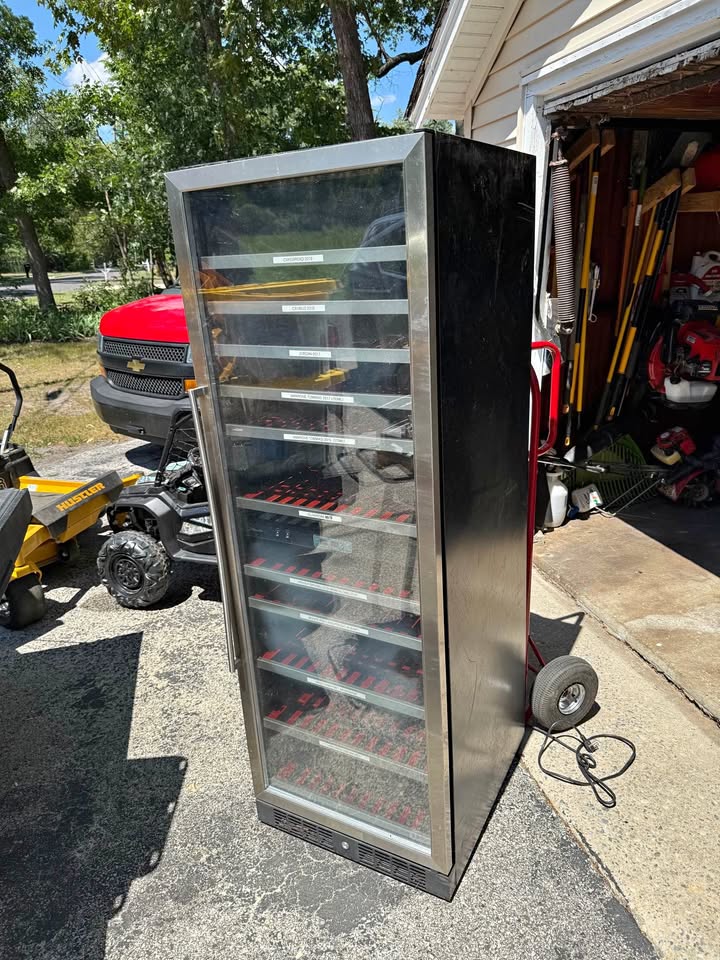
The Filament Fridge and the experiments behind it

A wine cabinet became a question about what the system was actually supposed to accomplish.

The reclaimed wine cabinet before its conversion into filament storage and a thermoelectric drying system.
The Filament Fridge · the cabinet as acquired, before the conversion.

The Filament Fridge is an active build: a reclaimed wine cabinet being rebuilt as an autonomous thermoelectric dehumidifier for 3D-printing filament. Its target is dry filament at or near room temperature. Cooling is the mechanism that condenses water out of the air.

An earlier specification treated lower temperature as success. Correcting the objective changed how the build was designed and measured. The commissioning target is a humidity pulldown curve, with a high plateau pointing first toward leakage rather than automatically toward inadequate cooling capacity.

The design uses separate air circuits, a thermoelectric cartridge, and local ESP32 control. Home Assistant observes the system; the controller doesn’t need the network to run the drying loop. The project record distinguishes measurements, decisions made with the parts in hand, and proposals still needing verification.

It’s another place where I publish the work while it is still work: constraints, redesigns, and the evidence needed to decide what comes next.

Read the Filament Fridge project The goal is dry, not cold

Writing the Work Down

Education, build logs, essays, and independent research

The explanation belongs beside the system.

I studied English and Communications at the University at Buffalo from 2003 to 2007, with a Comparative Literature minor. I was also lead editor of the university’s annual poetry publication. Writing and editorial work have remained part of how I develop and explain a project.

I publish technical build logs and long-form essays alongside the systems they describe. A project page can explain what the system does; a build log has room for the observation, failed assumption, or experiment that changed its direction.

Wallaby, my independent retrieval and comprehension research, is one example. It explores multiple interpretations over an immutable message record, with divergent probes and adversarial synthesis. In a bounded experiment, a reader holding 455 nodes missed material that a sixteen-way fan-out caught. That result changed the attention question being examined; it is not a general coverage guarantee.

The site keeps that kind of evidence visible across software and workshop work. Someone interested in a project can follow its brief into the reasoning and experiments behind it.

Browse the writing Read about Wallaby